The guiding principle of innovation procurement is to “begin with small taregets and rapidly expand.” Introducing this approach is often most effective when implemented as a gradual learning process. This means that the necessary changes for innovation procurement, whether they involve cultural shifts or procedural adjustments, do not have to occur all at once. A successful innovation project can be initiated from the grassroots level, starting with addressing simple, practical issues.
To initiate this process, one can start by identifying areas such as environment/climate change or healthcare that require attention and could benefit from innovative solutions. The initial emphasis should be on sectors and projects where innovation can be more easily integrated and can yield the most significant impact. By commencing with small projects, trust and confidence can be built, laying the foundation for the attraction of larger, more complex projects in the future.
Advantages of employing innovation procurement – for clients
- Enhancement of service modernization, efficiency, and quality.
- Provision of solutions tailored to specific, unmet needs or challenges.
- Potential for short and/or long-term cost reduction.
- Capability to discern market trends and discover novel solutions aligning with customer requirements.
- Exposure to a broader range of suppliers.
- Acquisition of knowledge and methodologies applicable to other projects.
- Chance to garner positive publicity and enhance reputation.
Advantages of employing innovation procurement – for suppliers
- Access to significant public sector clientele.
- Insight into challenges and priorities within the public sector.
- Opportunities for research, development, and commercialization of solutions.
- Potential to secure future contracts and enter new markets.
- Possibility of positive publicity.
- Chance to reinforce competencies and human capital capacity.
Innovation procurement holds significant strategic value, particularly in its capacity to bolster technological advancements within the public sector. The demand generated by public entities can serve as a catalyst, compelling industries reliant on public sector sales to innovate and adopt new technologies. Key public services like healthcare, water treatment, district heating, and transportation infrastructure, including roads and railways, heavily rely on public demand. In these instances, public procurement serves as the clear avenue for articulating this demand and propelling technological progress.
- Pre-commercial procurement (PCP) is utilized in situations where it is
- crucial to early on select multiple suppliers to identify the most suitable candidates for subsequent prototyping and testing stages.
- This approach aims to markedly diminish investment risks and enhance competitiveness by fostering the development of superior products.
- Following the creation of initial test samples, an innovation procurement procedure is implemented, evaluating both price and quality criteria.
- On the other hand, Innovation procurement procedures (PPIs) are opted for when there is a
- need to significantly minimize time invested in research and development (R&D).
- PPIs are particularly useful for acquiring a product or solution that is not currently available in the market.
- Additionally, they are chosen when it is imperative to incorporate the development of a prototype into the procurement contract.
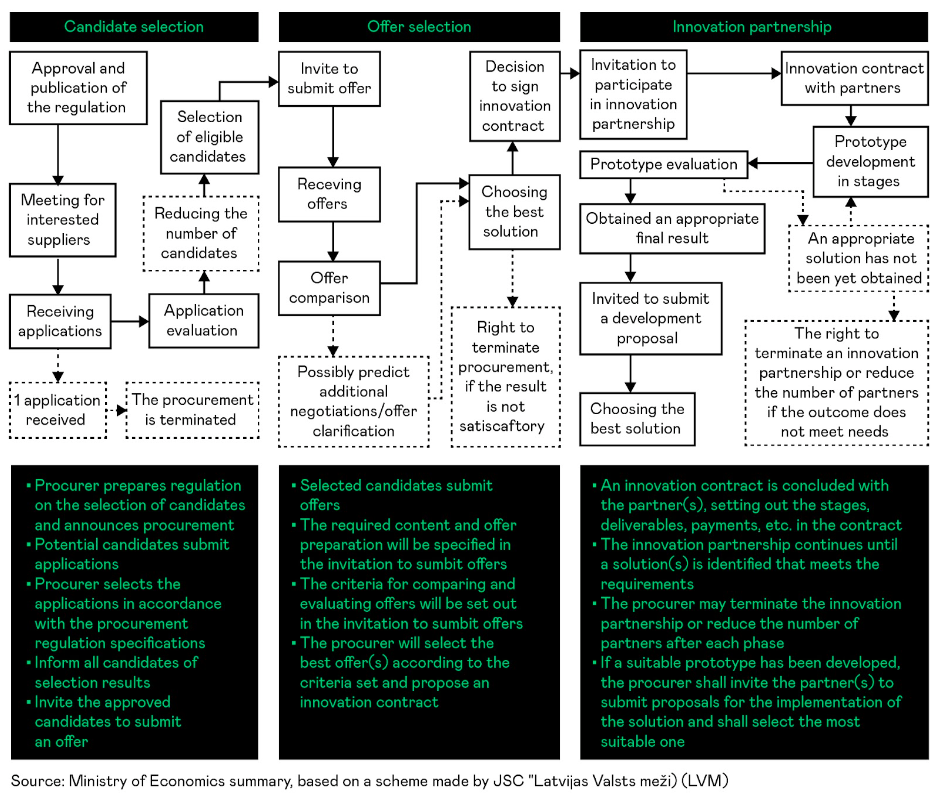
Before establishing an Innovation Partnership, it’s crucial to gain insights into the relevant market through activities like initiating prior consultations with potential suppliers. The customer should articulate their needs precisely, enabling market participants to comprehend the problem’s nature, associated risks, and the opportunities for engagement. Simultaneously, when structuring the procurement content, service providers should anticipate potential changes during the process, allowing for flexibility with input from market participants.
Public procurement regulations permit the formation of contracts with multiple innovation partners, deferring the final selection of deliverables throughout the contract duration. This approach facilitates the support of various innovative solutions, with the flexibility to choose one or more suppliers for implementation.
A targeted development of outcomes in the innovation partnering procedure is advisable. Given the intellectual nature of innovation, careful consideration of intellectual property matters, including determining the rights of beneficiaries and the usage rights of intellectual assets, is essential during the planning and design phases of the innovation partnership.
- Engaging in pre-procurement market consultations with industry players aims to conduct a comprehensive market analysis by directly gathering information from potential suppliers of innovative solutions.
- This process is particularly crucial for intricate procurement endeavors, where the customer may find it challenging to independently assess the technical, financial, and resource viability of the planned procurement.
- Using insights gleaned from these consultations, the contracting authority can refine the procurement specifications and determine the most suitable procurement procedure. Additionally, the authority can verify whether a viable solution already exists based on the information gathered during the consultation.
- Market research and guidance can take various forms, including:
- questionnaire consultations where tenderers respond to a set of questions,
- digital consultations facilitated through a platform connecting authorities with entrepreneurs,
- face-to-face counseling through events, or unconventional methods such as competitions, hackathons, or idea workshops. Telephonic counseling, involving structured interviews conducted by a third party to ensure impartiality, is also a viable approach.
In the context of innovation procurement, evaluating whether the outcome of innovation qualifies as a protected work is crucial, potentially making it a viable acquisition component. It is recommended to assess the transfer or retention of intellectual property rights to the public purchaser during the initial stages of needs identification and procurement planning. This involves weighing the societal benefits and drawbacks associated with both transferring and not transferring intellectual property rights.
When drafting documentation for innovation procurement, the preliminary contract should incorporate a clause granting the contractor the necessary intellectual property disposal rights. This is essential for the contractor not only to sell the product and its associated property rights but also to utilize it effectively in fulfilling the contract.
Particular attention should be devoted to addressing intellectual property rights in Information and Communication Technology (ICT) procurement. This entails considering the transfer of copyright in the developed information system or other ICT products to the public purchaser. Such a transfer empowers the purchaser not only to use the product for its own needs but also to enhance and develop it in the future.
“Green” Public Procurement (GPP) is a tool for environmental policy that may be used to systematically integrate environmental (including social) conditions into all operations linked to the procurement of goods or services:
- minimise environmental effects: the manufacture, use, recycling for future use, and landfill disposal of any good or service have an influence on the environment at every stage of its life cycle;
- Encourage social improvements: better working conditions can be guaranteed by including requirements in the procurement process, such as in the construction of new buildings that are accessible to the disabled;
- save money by planning purchases by determining what is truly needed before making a large number of purchases. Second, a review of the product’s life cycle expenses is conducted. This allows for the consideration of all relevant variables, including operating and waste management expenses in addition to the initial cost of the commodity or service, and eventually results in cost savings.
When a customer purchases a good or service through socially responsible public procurement, they are also making a positive social impact, which includes:
- purchasing goods made ethically;
- giving jobs to people who have left the workforce; enhancing working conditions for employees;
- requiring that those employed in the service provision undergo training;
- guaranteeing that workers receive wages commensurate with the labour market (sectoral agreements);
- and providing opportunities for small and medium-sized businesses, including social enterprises, to engage in public procurement.
Additionally, ethical and responsible buying encourages companies to manage their labour and production process more sustainably and responsibly. Therefore, socially conscious public procurement is a tactical instrument that successfully advances labour and social policy.